



The Complete Guide to Stove Fans: How They Work and Which to Choose
Even with a roaring fire lit, are you still feeling the cold in draughty spots and chilly corners in your home? You’ll be pleased to know that a really simple and cost effective solution exists: the humble stove fan.
But there’s a problem. There are so many different types, sizes and designs out there these days, you may be left scratching your head in confusion. This guide will help you to understand what questions you need to ask to find the right stove fan for what you need.
What is a stove fan?
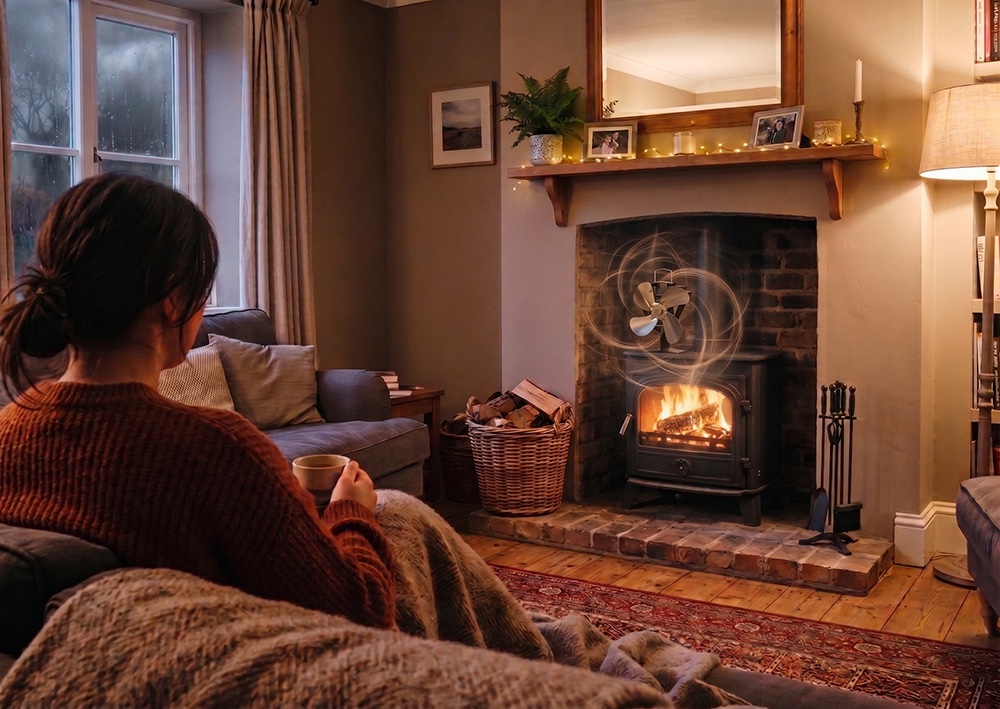
Stove fans (or log burner fans depending on who you ask!) sit on top of your wood burning stove or log burner, and help to circulate warm air around the room. They don’t produce heat themselves; instead, they distribute and make better use of the heat you’re already generating. Stove fans are sometimes described as eco stove fans because they use the heat from your stove to power the fan, rather than mains electricity or batteries.
How do stove fans work?
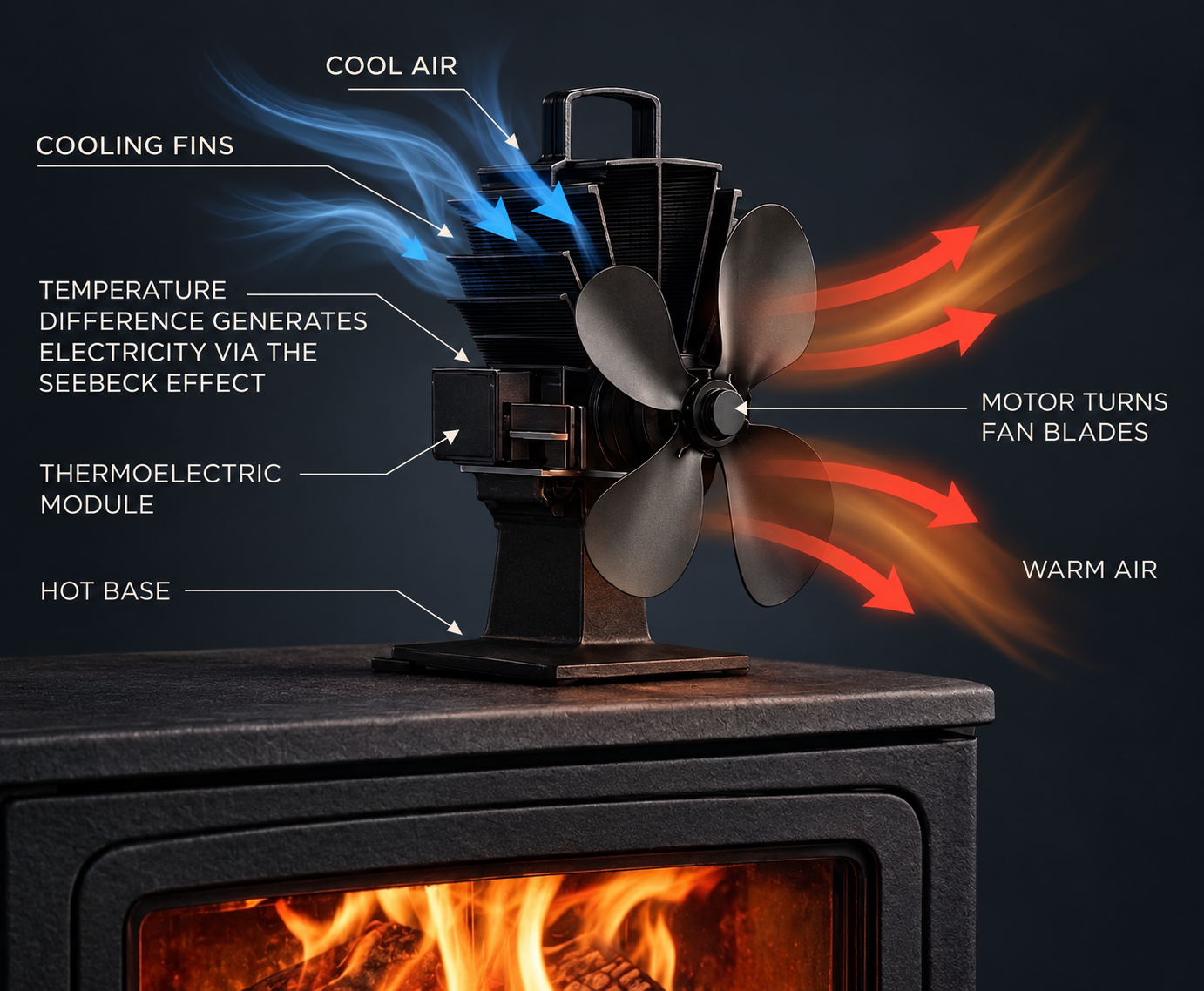
Now for the science bit. Stove fans work using the ‘Seebeck effect’, where a temperature difference between two sides of a thermoelectric module generates a small electrical current. This powers a built in motor, which turns the fan blades.
The heat from the stove warms the base of the fan while the cooling fins help dissipate heat from the other side of the module. This creates the temperature difference needed to generate the power that runs the motor.
It sounds complex, but it actually means stove fans are incredibly simple and easy to use. They power themselves with just your stove heat, no batteries or power cords needed.
WHAT IS CFM AND HOW DOES IT RELATE TO AIRFLOW?
You’ll see the acronym 'CFM' when you’re shopping for stove fans: this stands for cubic feet per minute. This is the most important thing to consider when you're choosing a model. CFM measures how much air a stove fan can move, a higher CFM means a greater volume of warm air is being circulated. Think of it like this, CFM is the measurement, and airflow is what’s being measured.
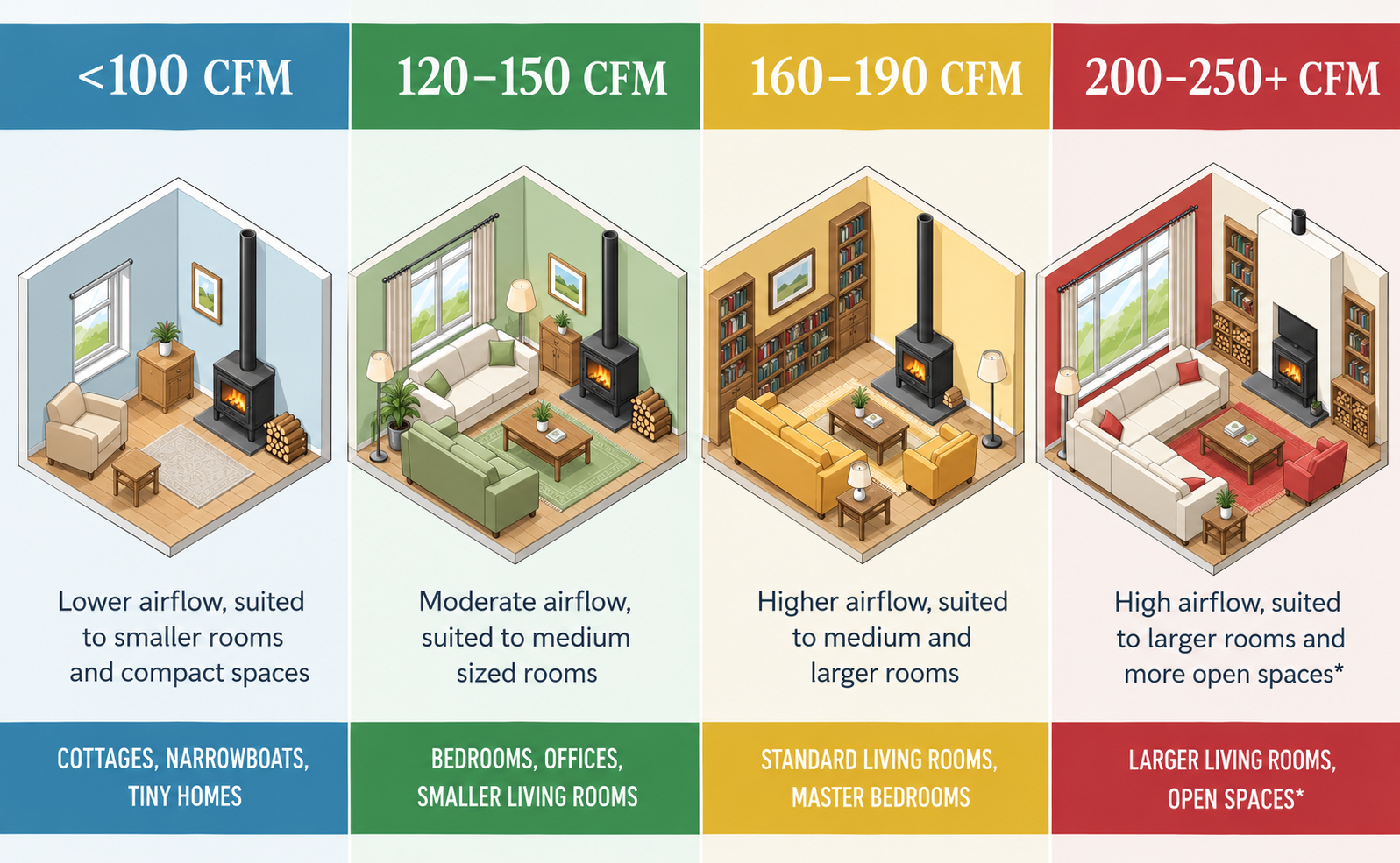
These are rough comparisons rather than fixed room size recommendations. Things like your stove, your room layout and how much air you need to circulate will all make a difference. It’s also important to note that even high CFM performance won’t move air into other rooms.
*For large open plan spaces, additional fans and the correct positioning will be needed.
What about size, and the number of blades?
More blades and bigger size doesn't necessarily mean 'better'. Blade count alone isn’t a reliable way to judge performance. The design of the blades and motor also affects how the fan operates, so when comparing models, look at the CFM to understand how much air they can move. When it comes to the size, larger fans can accommodate larger blades and can be capable of moving more air, but they also need more space on top of your stove. If your stove is positioned inside an inglenook or has limited clearance around the flue, be sure to check out dimensions before choosing a model. Again, looking at the CFM performance is a more accurate way to make your choice.
Want your room to heat up sooner?
A fan with a lower operating temperature can start circulating warm air earlier as your stove heats up and you can feel the benefits more quickly. Take our 85CFM Two Blade Stove Fan, which starts producing 50 CFM from as low as 65.5°C. Perfect for those chilly winter mornings!
Is heat getting trapped around your inglenook?
Having all of the heat from your fire concentrated around the inglenook can mean that half of your room still feels quite cold. Something like our 200-250 CFM Three Blade Stove Fan can move a high volume of warm air away from your heat source.
Compatibility
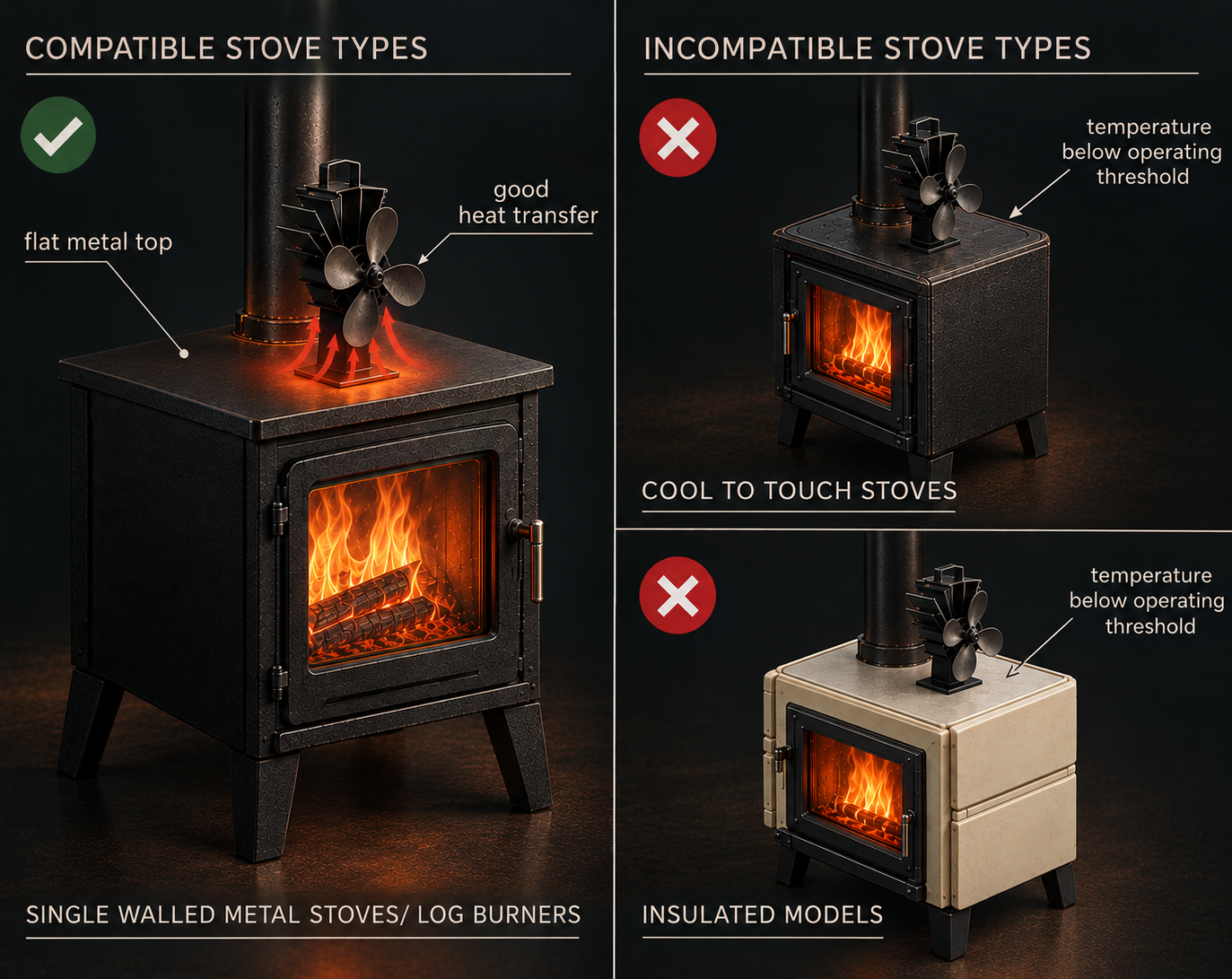
Stove fans work for many types of stoves, log burners and fireplaces, but there are some caveats. Since they rely entirely on direct thermal conduction to generate power, they need a flat and intensely hot metal surface to work, so can't be used with double-walled stoves and cool to touch/ insulated models that don't reach the required starting threshold (usually around 50°C to 80°C).
There’s an upper limit too, if the surface temperature gets too high then the thermoelectric motor can be damaged. Most stove fans have a built in safety strip that helps protect the motor by slightly tilting the fan away from the hot surface, but it’s still important to keep an eye on your stove temperature. You can do this with a magnetic stove pipe thermometer, which can let you know when it’s time to move your fan towards the cooler edge of the stove.
Why should I buy a stove fan?
If you already have a stove or log burner in place, this one simple addition can help you to get the best out of it. A stove fan will:
- Maximise the heat that your stove or log burner is already creating
- Reduce the amount of fuel you use by up to 19% (the room reaches a comfortable temperature faster, allowing you to turn down the stove sooner)
- Remain hassle free with no installation, batteries or annoying power cords
- Start and stop automatically as your fire heats and cools
- Run quietly without disturbing you relaxing or watching tv
- Look great on your fireplace adding a stylish finishing touch
READY TO GET MORE OUT OF YOUR LOG BURNER?